
Games leave a receipt in the brain.
Published Sep 16, 2026Edited Sep 16, 2026
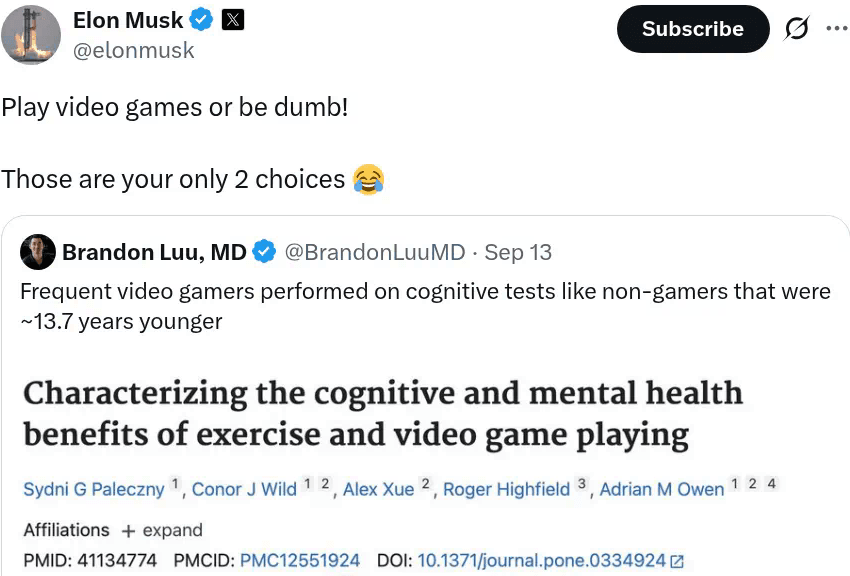
Elon Musk put it bluntly this week: “Play video games or be dumb! Those are your only 2 choices.” He was quoting a chart that said frequent gamers scored on cognitive tests like non-gamers roughly 14 years younger. The joke travels. The underlying claim is older, and more careful, than the meme.
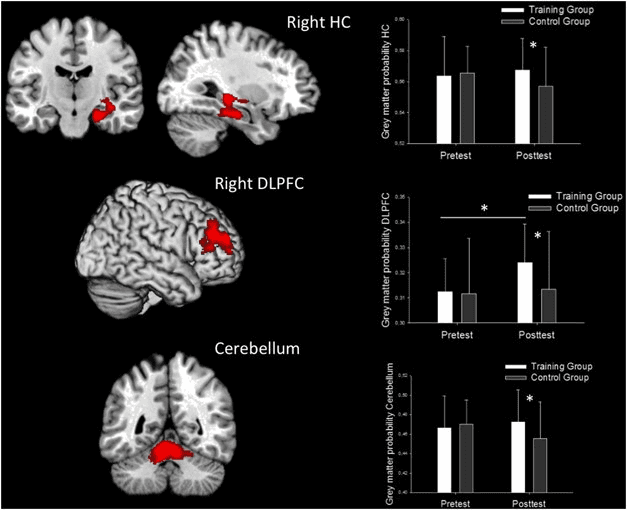
A 2014 study in Molecular Psychiatry trained adults on a commercial platformer (Super Mario) for at least 30 minutes a day over two months. Compared with controls, the training group showed measurable gray-matter increases in the right hippocampus, right dorsolateral prefrontal cortex, and bilateral cerebellum — regions tied to spatial navigation, strategic planning, working memory, and motor control. Hippocampal growth tracked a shift toward allocentric (map-based) navigation. Desire to keep playing predicted more growth in hippocampus and DLPFC. That is structural plasticity from a game, not vibes.
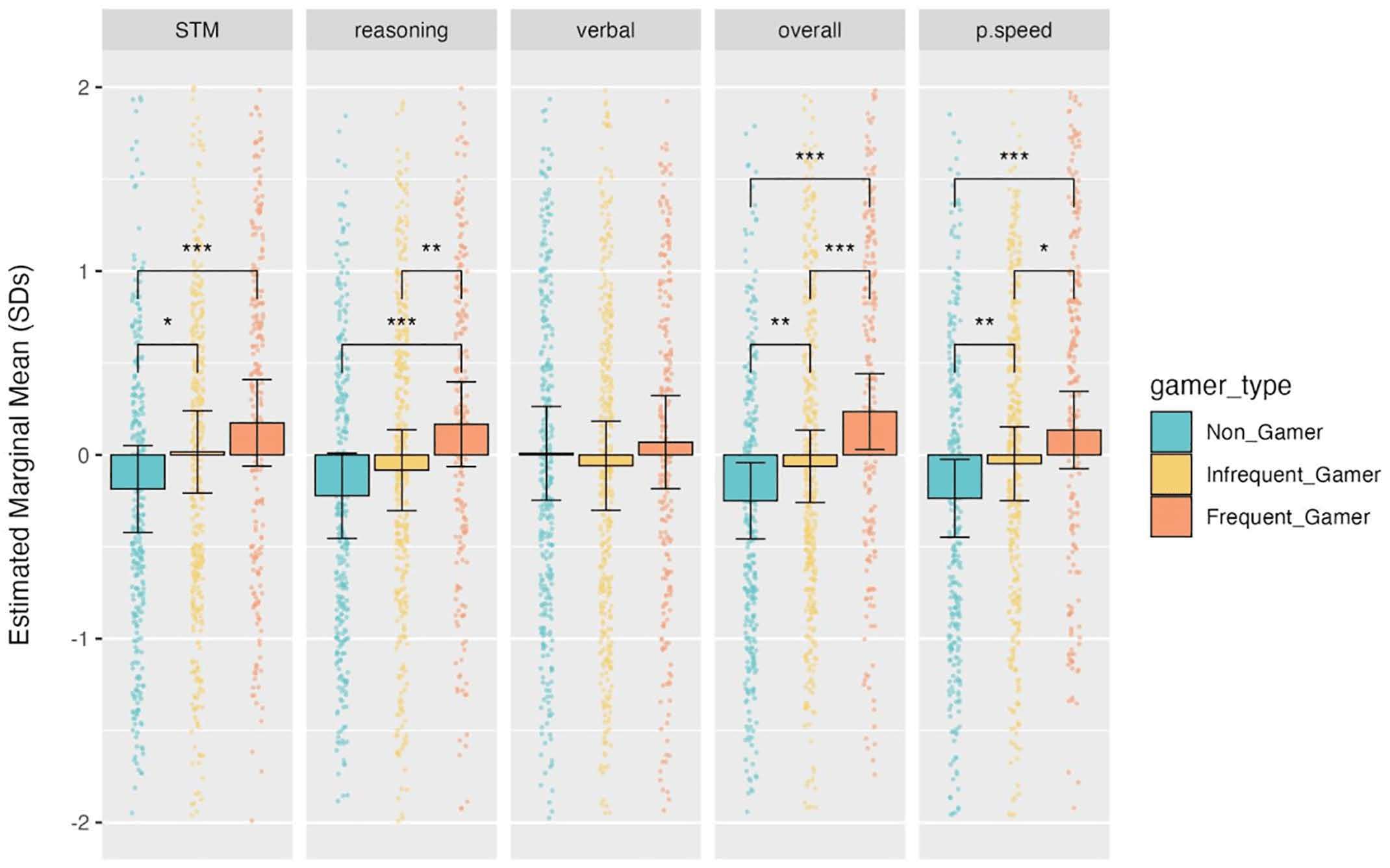
A newer PLOS ONE paper (2025) looked cross-sectionally at exercise and video gaming across a large online sample. More physical activity linked to better mental-health screens, not better cognition scores. More time gaming linked to better cognitive performance (memory, reasoning, processing speed), not mental health. Association, not proof that “games make you smart.” Still: the pattern keeps showing up — practiced play correlates with brain and test outcomes that passive scrolling does not.
That is the news.
Tech Lab Take
The culture war treats games as either babysitting or brain rot. The receipts say something narrower: intense, rule-bound play is training. It leaves measurable change — gray matter in one study, cognitive scores in another — when the task demands navigation, planning, and motor skill under feedback.
That is why BarKade and ArcadeBench exist inside the lab. Games are not the product ceiling; they are the cleanest place to watch a decision, score it, cost it, and compare it. If intelligence is going to leave a receipt — what it cost, whether it was worth it — a board or a level with fixed rules is where that habit starts. Adults who train judgment in public, inspectable play are doing the opposite of disposable tokens: they are practicing under constraints and keeping the evidence.
This is not “games cure disease,” and it is not a school curriculum pitch. It is refusing the dumb binary. Play can be training. Training without a receipt is still noise. Measure the play, publish the result, then argue about what the brain actually did.
— BK